Minimum Wage Increases Take Effect October 1 in Five Provinces
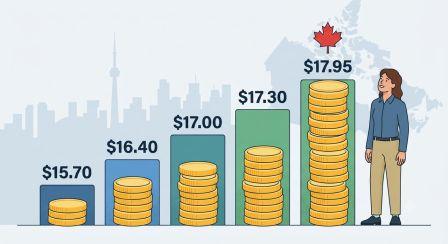
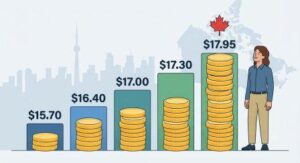
An infographic illustrating the rising minimum wage rates across Canadian provinces, featuring monetary values set against a backdrop of a Canadian city skyline and map outline.
Five provinces are raising their general minimum wage on October 1, 2026: Ontario, Manitoba, Nova Scotia, Saskatchewan, and Prince Edward Island. Anyone living in — or planning a move to — one of these provinces should know the new numbers, since they affect take-home pay for millions of workers and factor into whether a given hourly job actually covers the local cost of living.
The new rates
| Province | Previous rate | New rate (Oct 1, 2026) | Increase |
|---|---|---|---|
| Ontario | $17.60 | $17.95 | +$0.35 (2.0%) |
| Manitoba | $16.00 | $16.40 | +$0.40 (2.5%) |
| Nova Scotia | $16.75 | $17.00 | +$0.25 |
| Saskatchewan | $15.35 | $15.70 | +$0.35 (2.3%) |
| Prince Edward Island | $17.00 | $17.30 | +$0.30 (1.8%) |
Nova Scotia’s increase is its second of 2026 — the province already moved from $15.65 to $16.75 on April 1, with this October adjustment bringing it to $17.00. PEI has also confirmed a further increase to $17.60 already scheduled for April 1, 2027, giving workers there visibility into next year’s rate well ahead of time.
Why these particular dates
None of these are one-off political decisions — each province adjusts its minimum wage on a set annual schedule, tied to a formula based on the Consumer Price Index (CPI), either provincial or national depending on the jurisdiction. Manitoba’s increase, for example, reflects the province’s 2025 inflation rate rounded up to the nearest five cents under its Employment Standards Code. Ontario’s October adjustment is based on Ontario CPI data from the previous calendar year. The predictability is deliberate: several provincial officials have framed these formula-driven increases as a way to protect workers’ purchasing power without the abrupt, larger jumps that come from ad hoc political announcements.
How this compares to the federal minimum wage
Workers in federally regulated industries — banking, telecommunications, and interprovincial transportation, among others — are covered by a separate federal minimum wage, which rose to $18.15 per hour on April 1, 2026. All five of the October 1 provincial rates above remain below that federal figure, meaning federally regulated employees in these provinces are entitled to the higher $18.15 rate regardless of their province’s general minimum wage. For everyone else, the applicable provincial or territorial rate governs.
What this means in annual terms
For a full-time worker on a standard 2,080-hour work year, these increases translate to real, if modest, annual gains. In Prince Edward Island, for instance, the move from $17.00 to $17.30 adds roughly $624 a year in gross pay for someone working full-time at minimum wage — a small but tangible shift against a period in which grocery and housing costs have climbed sharply across the country.
The gap that remains
Even with these increases, minimum wage in every one of these provinces still sits meaningfully below independently calculated “living wage” benchmarks — the hourly rate a single full-time worker would need to cover basic expenses in a given city, as estimated annually by the Canadian Centre for Policy Alternatives. In Nova Scotia, the new $17.00 minimum remains roughly $12 below the calculated living wage for Halifax; in PEI, the $17.30 rate sits several dollars below the province’s own average living wage. That gap is a recurring point of disagreement between labour groups, who argue the increases don’t go far enough, and business associations, which have raised concerns — particularly in Nova Scotia’s case — about the added cost pressure of two increases in a single year for small employers.
What to check if you’re affected
If you work in, or are moving to, any of these five provinces, it’s worth confirming your new hourly rate takes effect correctly on your first pay period after October 1 — payroll updates don’t always land exactly on the effective date. Workers in Ontario should also note the lower youth and homeworker rates update alongside the general minimum wage, so students and workers in those specific categories should check the province’s updated rate table rather than assuming the general rate applies to them.
Sources:
- Which 5 provinces are increasing minimum wage rates in October? — Canadian HR Reporter
- Canada: Minimum Wage Increases Effective October 1, 2026 — Littler
- Minimum wage in Canada — Wikipedia (compiled from provincial government sources)