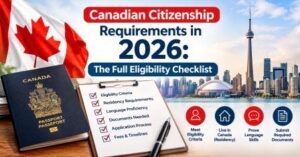
Canadian Citizenship Requirements in 2026: The Full Eligibility Checklist
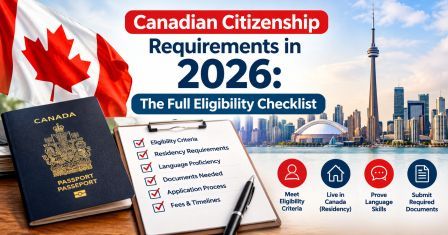
Canadian Citizenship Requirements in 2026: The Full Eligibility Checklist.
For permanent residents thinking about the next step, Canadian citizenship isn’t a single form — it’s a set of separate requirements that all have to be met at once. Here’s what actually has to line up before an application is worth submitting.
Permanent resident status, in good standing
Every applicant must currently hold permanent resident (PR) status, with no unresolved immigration issues — no active removal order, no ongoing review for misrepresentation, and no outstanding conditions on that status. A PR card itself can be expired at the time of application; what matters is the underlying status, not whether the physical card is current.
The 1,095-day physical presence rule
This is the requirement most applicants spend the most time calculating. An applicant must have been physically present in Canada for at least 1,095 days (three years) within the five years immediately before signing the application.
A few details that trip people up:
- Time spent in Canada before becoming a permanent resident — as a temporary resident (worker, student, visitor) or as a protected person — can count toward this total, but only at half credit, and only up to a maximum of 365 days.
- The five-year window is calculated backward from the date the application is signed, not the date it’s submitted.
- IRCC recommends applying with more than the bare minimum of 1,095 days, since applicants sometimes miscalculate their own travel history and a shortfall means the application gets returned.
Tax filing
Applicants must have filed income tax returns, if required to do so under the Income Tax Act, for at least three of the five years within the eligibility period. This is checked against CRA records as part of the application, so gaps in filing — even for years with little or no income — can hold up an otherwise-eligible application.
Language requirement (ages 18–54)
Applicants between 18 and 54 years old must demonstrate they can speak and listen in English or French at Canadian Language Benchmark (CLB) level 4 or higher. Accepted proof includes:
- Results from an approved third-party test (CELPIP-General or IELTS-General, for English; TEF for French)
- Transcripts from a secondary or post-secondary program completed in English or French, in Canada or abroad
- Proof of completing CLB 4 through certain government-funded language training programs (such as LINC/CLIC)
Applicants under 18 or 55 and older are exempt from this requirement, and from the citizenship test below.
The citizenship test
Applicants aged 18 to 54 must also pass a knowledge test based on the official study guide, Discover Canada. The test currently runs online and self-administered:
- 20 questions, multiple-choice or true/false
- 45 minutes to complete it
- A minimum score of 15 out of 20 to pass
- Applicants get a limited number of attempts before being referred to an in-person or virtual hearing with a citizenship official instead
Fees
As of the most recent fee schedule, the cost to apply is:
- $630 for an adult applicant (18 and over)
- $100 for a minor applicant (under 18)
- $100 for a stateless adult born to a Canadian parent
Fees are paid online regardless of whether the rest of the application is filed online or on paper, and IRCC advises paying only once the application package is otherwise ready to submit, since the payment receipt has to be included with it.
Processing time and the oath
Once an application clears review and, where applicable, the test and any interview, the final step is the oath of citizenship, which can be completed in person or virtually. Current published service standards put average processing for a routine adult application at roughly 12 months from submission to the oath, though individual cases vary depending on completeness and any additional verification required.
A note on citizenship by descent
Everything above covers citizenship by grant — the route most permanent residents use. Citizenship by descent, for people born outside Canada to a Canadian parent, is a separate legal pathway with its own rules, and those rules changed with Bill C-3, which came into force in December 2025 and removed the previous first-generation limit on passing citizenship down by descent. Anyone exploring citizenship through a Canadian parent or grandparent rather than through permanent residence should treat this as a distinct process with its own eligibility test, not a variation on the naturalization steps above.
Official sources: