Canada’s 2026 Federal Tax Brackets, Explained
Canada uses a progressive, marginal tax system at the federal level, meaning higher tax rates only apply to the portion of income within each bracket — not to all of a person’s income once they cross a threshold. That distinction trips up a lot of people, so it’s worth spelling out alongside the current bracket numbers.
2026 federal tax brackets
For the 2026 tax year, the federal brackets are:
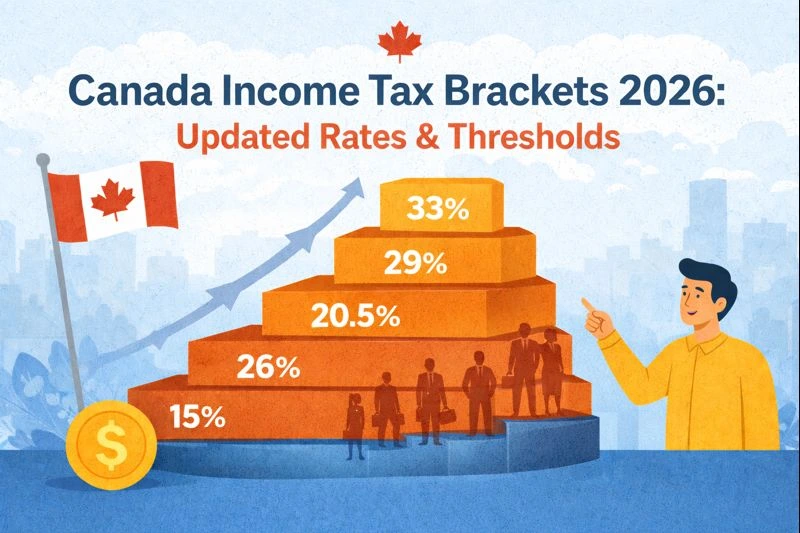
- 14% on taxable income up to $58,523
- 20.5% on the portion from $58,523 to $117,045
- 26% on the portion from $117,045 to $181,440
- 29% on the portion from $181,440 to $258,482
- 33% on the portion above $258,482
These thresholds are indexed to inflation each year, so they shift slightly annually — the CRA publishes updated figures each fall for the coming tax year.
How marginal rates actually work
Someone with $70,000 in taxable income doesn’t pay 20.5% on the whole amount. They pay 14% on the first $58,523, and 20.5% only on the remaining roughly $11,477. Their average tax rate ends up well below their marginal rate — the rate that applies to their last dollar earned. This is why moving into a higher bracket doesn’t reduce a person’s overall take-home pay; it only raises the rate on income earned above that threshold.
The Basic Personal Amount
The Basic Personal Amount (BPA) is a non-refundable credit that effectively means the first portion of everyone’s income is untaxed federally. For 2026, the maximum BPA is $16,452, meaning Canadians earning that amount or less owe no federal income tax at all. The full BPA is available to individuals with net income up to $181,440; above that, it phases down gradually to a minimum of $14,829 for income at or above $258,482.
Don’t forget provincial tax
The brackets above are federal only. Every province and territory layers its own tax brackets and rates on top, with its own thresholds and its own basic personal amount — so total marginal tax rates vary significantly depending on where in Canada someone lives. Provincial tax authorities publish their own bracket tables separately from the CRA’s federal numbers.
Why this is worth understanding
Bracket confusion leads to two common mistakes: turning down a raise or extra shift out of a mistaken belief it will “push you into a higher bracket and cost you money” (it won’t — only the incremental income is taxed at the higher rate), and underestimating how much of a large one-time payment, like a bonus, will actually be withheld. Understanding marginal versus average rates clears up both.
Official sources:
- Canadian income tax rates for individuals — current and previous years — CRA
- All Rates — Canada Revenue Agency